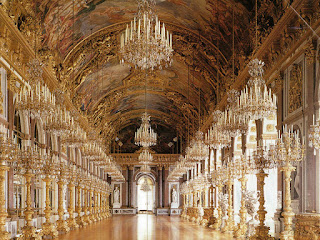
And that’s where Angie and Hugh went this past December. Staying at the Antiche Figure Hotel, a 16th century beauty located across the Grand Canal from the train station, they spent a week seeing pretty much everything one could imagine.
One of the great things about Venice in the winter is that it’s pretty easy to walk down the sidewalks, something that can be a bit of a challenge in the summer when there are so many people. On the other hand, floating down the sidewalks in the winter isn’t unheard of that’s when the city is traditionally most affected by extraordinary tides that can result in high tides 6 ft. above normal… (They are called the Acqua Alta) Which can be a problem for a city built at sea level… In such instances one would walk on the passarelle, the elevated walkways that are set up around the city… or bring galoshes. Luckily our intrepid adventurers didn’t have to worry about flooding this year.
 Of course the trip begins with the Doge’s Palace and works around the city from there. Venice seems to have something to see around every corner and across every bridge. There is St. Mark’s Square where the winter chill can be warmed by the liquid gold of Café Florian’s hot chocolate, the Basilica di Santa Maria Gloriosa dei Frari church with Giovanni Bellini’s Madonna and Child altarpiece, and the Gallerie dell'Accademia with masterpieces from the likes of Titian, Canaletto and da Vinci. The Accademia was particularly fascinating because it’s just recently come out of renovation and as a result the colors were extraordinarily vibrant and the walls and the ceilings seemed like they’d just been presented for the first time.
 Angie and Hugh particularly enjoyed the Ca' Rezzonico, not far from the Accademia. This canal facing beauty is dedicated to 18th century Venice and features wonderful pieces of art as well as spectacular frescos, but its real treasure is its collection of period piece furniture. They also visited the Galleria Giorgio Franchetti alla Ca' d'Oro, better known as Ca’ d’Oro, which means Golden House. The collection, much of which was accumulated in the 19th century by banking baron Giorgio Franchetti, is one of the most eclectic in Venice, consisting of paintings, sculptures, reliefs, fragments and a number of spectacular frescos.
But Venice is not all about public museums or cathedrals. One of the fascinating things about Venice is that there is no shortage of houses that have been turned into museums. For people in the antique business like Hugh and Angie, that is a little like being kids in a candy store. Although antique prices are typically too high to be able to ship and sell at a profit, from a research perspective it’s a goldmine. From lighting and mirrors and furniture to sunbursts and fragments and statuary, Venice gives one a wonderful opportunity to see pieces in their original settings, with original paints and often still being used for their original purposes.
Then of course there are the canals… While walking the narrow crooked streets of Venice is part of the city’s charm, the canals are Venice. Although from seeing Casino Royale, From Russia With Love or The Italian Job one might imagine that everyone in the city gets around by speedboat, the reality is that the primary vehicles in Venice are the water taxis and the romantic gondolas. Running throughout the year – except when strikes strike – they are a wonderful way of getting around. But of course, did we mention that it’s cold in December? When not walking about Angie and Hugh opted for the water taxis, which are like New York City’s tourist busses, you get on and off at different locations around the city as it fits your itinerary. Sure, it’s cold on the taxis too… but they get you to your destination much faster than the gondolas or walking!
Finally, given that the city is basically a collection of buildings separated by canals that one has to cross every so often, there are the bridges. Angie and Hugh may not have crossed every one, but they crossed quite a few, including the Ponte degli Scalzi, the Ponte dell'Accademia and of course the Bridge of Sighs. Sadly however, as it was under construction, they were unable to cross what is perhaps the city’s most beautiful bridge, the Rialto.
So, now that we’ve explored Venice, the second part of the trip, Florence, will be coming up soon. Below are some of our duo's pictures from Venice.

Lion fresco from Basilica di Santa Maria Gloriosa dei Frari

Altar in the Basilica di Santa Maria Gloriosa dei Frari

A floor to ceiling door panel in the Scuola Grande di San Rocco.

A ceiling panel in the Scuola Grande di San Rocco featuring paintings by Tintoretto, who was commissioned to do most of the paintings in the building.

A chandelier in the Ca' Rezzonico.

Another chandelier in the Ca' Rezzonico.

A chair in the Ca' Rezzonico.

A marble floor in the Ca' Rezzonico.

Venetian ribbon back chairs.
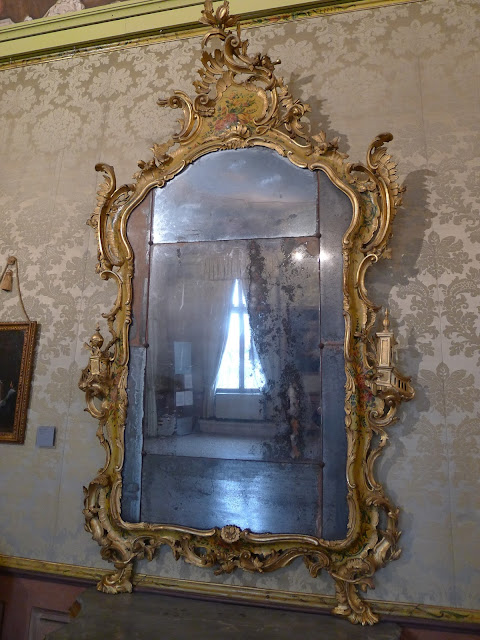
A mirror in the Ca' Rezzonico.

A chest in the Ca' Rezzonico.

Another mirror in the Ca' Rezzonico.

A Vaporetto stop - where one picks up the water taxi.

The Grande Canal.

The Rialto Bridge, which was under construction and covered with a faux facade.

A statue standing on the inlaid tile floor in the Ca’ d’Oro, which is more often than not under water this time of year.

The facade of the Gallerie dell'Accademia.

Giant works in the Gallerie dell'Accademia painted by Titian.

Madonna and Child - Giovanni Bellini in the Accademia.

The bell tower of St. Mark's Basilica towers above St. Mark's Square and the Doge's Palace.

A cabinet in the Doge's Palace.

Fragments from the exterior of the Doge's Palace.

Directions anyone? Giant globe and map in the Doge's Palace.

Although these walls in the Doge's Palace may look like they feature frescos, in reality these are giant paintings which were painted specifically for these walls.

Jail cells connected to the Doge's Palace which can only be reached by crossing the appropriately named Bridge of Sighs.

The Lion of St. Mark, the symbol of Venice, on the facade of the Doge's Palace.

Interior of St. Mark's Basilica.

St. Mark's Basilica.

A mosaic on the exterior of St. Mark's Basilica.

Off duty Gondolas moored near St. Mark's Square.

Venice at sunset from the Ponte degli Scalzi, literally, "bridge of the barefoot [monks]".